Enterprise Architecture 101
Most organisations don't fail because they lack talent or technology. They fail because nothing connects. Strategy lives in PowerPoint. Technology lives in silos. And somewhere in between, value gets lost.
That's the problem Enterprise Architecture solves.
What Enterprise Architecture Really Is
Enterprise Architecture (EA) is the discipline that aligns an organisation's business strategy with its technology, data, and processes so the whole enterprise works as one coherent system—not a collection of disconnected solutions.
Think of it as the blueprint for how a company operates and evolves. EA turns strategy into an executable blueprint.
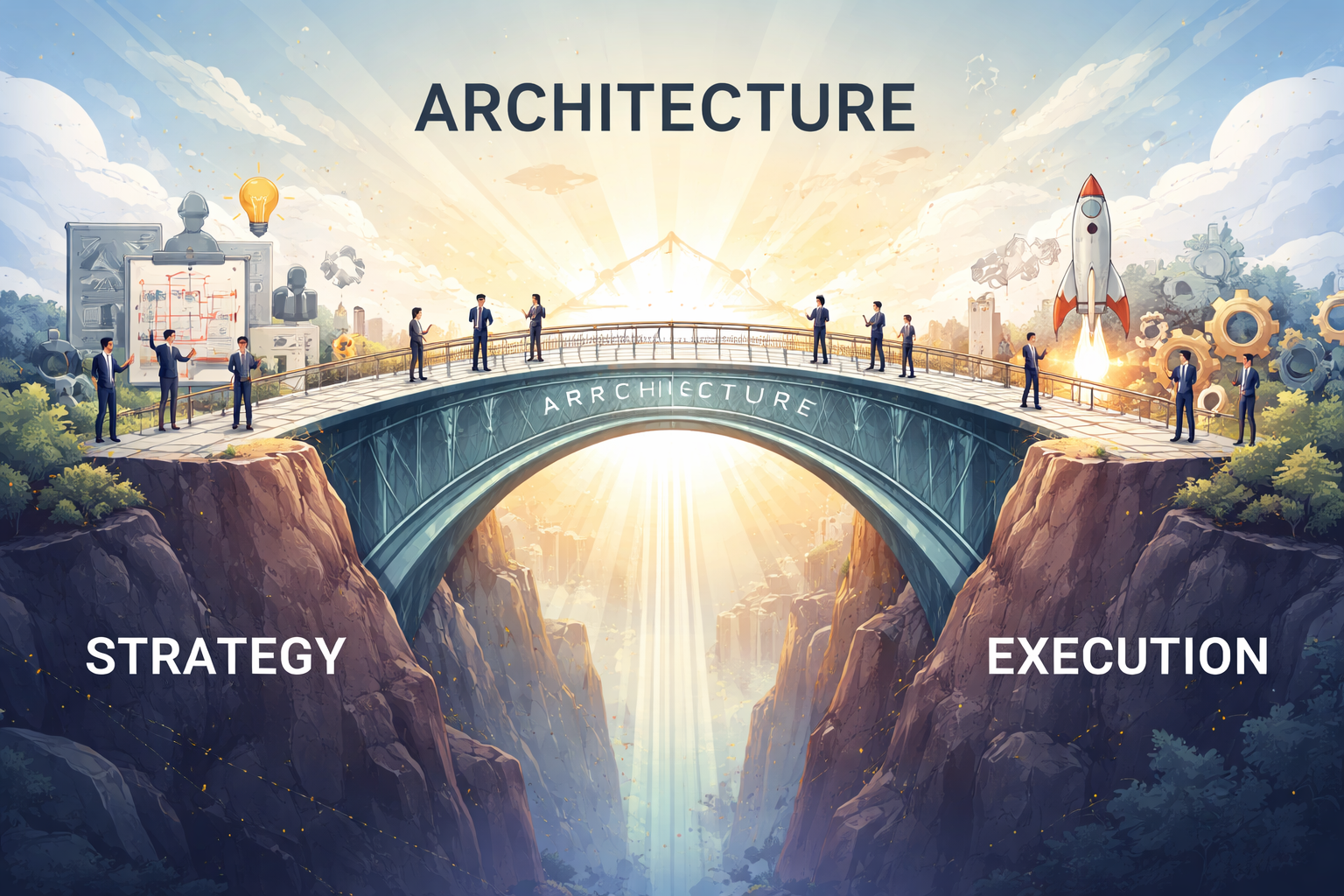 Strategy = the intention. What the business want to be
Architecture = the interpretation of business strategy
Execution = the implementation. How the business runs
Strategy = the intention. What the business want to be
Architecture = the interpretation of business strategy
Execution = the implementation. How the business runs
A Simple Way to Understand It
If an organisation were a city:
- Business strategy = why the city exists and how it wants to grow
- Processes = how people move, work, and interact
- Applications = buildings and services (banks, hospitals, shops)
- Data = information flowing through the city
- Technology = roads, electricity, water, internet
Enterprise Architecture is the city plan that ensures everything fits together, scales, and doesn't collapse under growth.
What Enterprise Architecture Actually Does
1. Creates Shared Understanding
EA provides clear models and language so executives, business leaders, and technologists all see the same picture. No more talking past each other.
2. Connects Strategy to Execution
It translates "where we want to go" into:
- Capabilities we must have
- Systems we must build or buy
- Platforms we must invest in
3. Manages Complexity
As organisations grow, systems multiply. EA reduces duplication, improves integration, and makes trade-offs explicit.
4. Guides Change
EA helps answer the hard questions:
- What should we modernise first?
- What can we safely retire?
- What dependencies will this change affect?
The Core Layers of Enterprise Architecture
Most EA frameworks cover four connected layers:
🧠 Business Architecture
- Business goals and strategy
- Capabilities (what the business must be able to do)
- Value streams and processes
📦 Application Architecture
- Systems and services
- How applications interact
- Ownership and lifecycle
🗂 Data Architecture
- Key business data
- Ownership and quality
- Data flows and integration
🖥 Technology Architecture
- Infrastructure and platforms
- Cloud, networks, security
- Standards and constraints
EA ensures these layers stay aligned as the organisation changes.
What Enterprise Architecture Is Not
❌ Not just diagrams
❌ Not only about technology
❌ Not a one-off document
❌ Not bureaucracy for its own sake
✅ It's a continuous decision-support discipline
Why Enterprise Architecture Matters
Without EA:
- Strategy and delivery drift apart
- Technology costs spiral
- Change becomes slow and risky
With good EA:
- Faster, safer change
- Better investment decisions
- Technology becomes an enabler, not a blocker
Enterprise Architecture vs Solution Architecture
Here's where people get confused. Let me clear it up.
The Shortest Possible Explanation
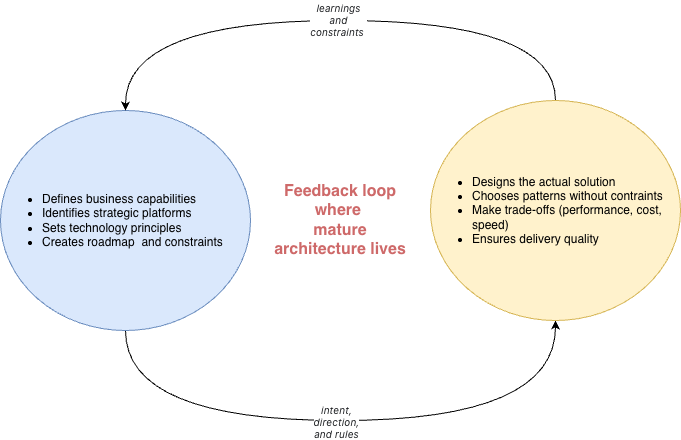
Enterprise Architecture decides what problems the organisation should solve and how the whole system should evolve.
Solution Architecture decides how to solve a specific problem correctly, within those boundaries.
👉 EA = direction and guardrails
👉 SA = execution and design
Side-by-Side Comparison
| Dimension | Enterprise Architecture | Solution Architecture |
|---|---|---|
| Scope | Entire organisation | Single project or product |
| Timeframe | Long-term (3-5+ years) | Short to medium-term (months to 1-2 years) |
| Focus | What and why | How |
| Primary concern | Strategic alignment and coherence | Delivery and quality |
| Stakeholders | Executives, business leaders, CTO | Project teams, product owners, developers |
| Key question | "What capabilities do we need?" | "How do we build this solution?" |
| Outputs | Principles, standards, roadmaps, reference architectures | Solution designs, technical specs, integration patterns |
| Decisions | Platform choices, technology standards, capability investments | Technology implementation, design patterns, component selection |
| Success measure | Enterprise agility, reduced complexity, strategic alignment | Solution delivery, performance, maintainability |
| Change frequency | Evolves gradually | Changes per project |
| Abstraction level | High-level, conceptual | Detailed, concrete |
| Constraints | Sets the constraints | Works within the constraints |
How They Work Together (This Is the Important Bit)
An Analogy
EA is like urban planning—defining where roads go, zoning requirements, building codes.
Solution Architecture is like designing a specific building—it must follow the city's codes and fit into the infrastructure, but focuses on making one building work well for its specific purpose.
Common Failure Modes
When EA Is Missing
- Every solution invents its own way
- Duplication everywhere
- Strategy ≠ delivery
- "Why do we have 7 systems doing the same thing?"
When SA Ignores EA
- Local optimisation, global damage
- Beautiful solutions that don't scale
- Hidden technical debt
- Architecture theatre ("it works for this project...")
The Bottom Line
Enterprise Architecture is the practice of designing and governing how an organisation's strategy, processes, information, and technology fit together to achieve sustainable business outcomes.
It's not optional. It's not overhead. It's how you ensure your business can actually execute on its strategy without drowning in complexity.
Because at the end of the day, your technology should enable your business—not hold it hostage.